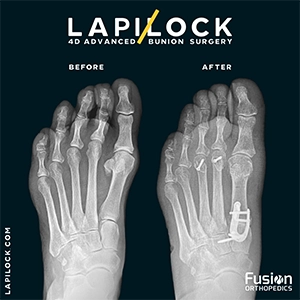
Break-through bunion surgery is finally here with the FDA cleared 4D Advanced Bunion Surgery.
LapiLock Bunion surgery requires the realignment of your toe and a surgical implant to fuse the unstable joint. The patented 4D Advanced Bunion Surgery by Fusion Orthopedics provides realignment and 13+ unique implant options for bunion surgery depending on surgeon preference and patient needs.
The LapiLock 4D Advanced Bunion Surgery
Break-through Bunion Surgery is finally here with the FDA cleared LapiLock 4D Advanced Bunion Surgery.
LapiLock Bunion surgery requires the realignment of your toe and a surgical implant to fuse the unstable joint. The patented LapiLock 4D Advanced Bunion Surgery by Fusion Orthopedics provides realignment and 13+ unique implant options for bunion surgery depending on surgeon preference and patient needs.
*Individual surgical results and recovery vary due to each person’s unique circumstances, anatomy, surgeon skill and many other factors.
Your Bunion Can Get Progressively Worse
The longer you put off bunion treatment and bunion surgery the higher the chances the pain and discomfort will increase over time. The pain can even reach a point when it becomes difficult to perform every day activities like walking and standing. Along with increased pain, you might notice your big toe becomes more deformed as time passes. Nerves can be damaged, resulting in numbness. The worst stage of bunion progression is the complete dislocation at the big toe joint and the big toe crosses with the second toe. Resulting in other complications and foot deformities, such as hammertoes. The progressive pain from a bunion can impair your movement and stability.
Determine now if bunion surgery with LapiLock is appropriate for you. This decision can greatly impact your quality of life.
*Individual surgical results and recovery vary due to each person’s unique circumstances, anatomy, surgeon skill and many other factors.
The Problem With Outdated 2D Bunion Surgery
In this 2D bunion surgery, the Metatarsal head was shaved to fake the cosmetic appearance of the foot.
The Metatarsal bone was cut in half to cheat the alignment and then the bone was screwed together.
A root cause of bunions is a complex genetic deformity of this unstable joint. Left unaddressed the metatarsal bone may drift out of alignment.
Many surgeons cosmetically address the common genetic deformity of bunions with outdated 2D bunion surgery. First, by shaving the bump to reduce its ugly appearance. Second, cutting the metatarsal bone in half and pushing it over.
A root cause of some bunions is the genetically unstable cuneiform joint, which often remains uncorrected! Many surgeons often overlook the coronal plane rotation of the problematic metatarsal. 2D bunion correction has resulted in dissatisfied bunion surgery outcomes for many patients.
Many surgeons cosmetically address the common genetic deformity of bunions with outdated 2D bunion surgery. First, by shaving the bump to reduce its ugly appearance. Second, cutting the metatarsal bone in half and pushing it over.
A root cause of some bunions is the genetically unstable cuneiform joint, which often remains uncorrected! Many surgeons often overlook the coronal plane rotation of the problematic metatarsal. 2D bunion correction has resulted in dissatisfied bunion surgery outcomes for many patients.
4D Advanced Bunion Surgery is the leading technology for bunion correction in the world today!
Have A Bunion?
Bunions Are Uprooting.
Old 2D
Fix the Root Cause of Your Bunion
✅
Completely
realigns
Your
Toe.
❌
Trims the
Bump off of
your Bone
to fake cosmetic appearance.
vs
vs
vs
✅ Reinforces the new alignment with implants to enhance stability.
❌
Cuts your
Bone in half
and slides it
over to cheat alignment.
✅ Total realignment addresses a root cause of Bunions to help prevent reappearance.
❌ Reduces the appearance of the Bump but often leaves a root problem unaddressed.
New 4D
Understanding 4D Advanced Bunion Surgery
1 - Car's Tire Alignment
Like a Car’s Tires, your bone can rotate out of alignment causing abnormal wear and tear. 4D Advanced Bunion Surgery can realign your toe at the joint.
2 - Falling Tree
Like a falling tree, your big toe starts slanting outwards creating an ugly bump on the outside of your foot. With 4D Advanced Bunion Surgery, the problematic bones are realigned.
3 - Stool's Short Leg
If your Big Toe is improperly lifting off the ground like a stool’s short leg 4D Advanced Bunion Surgery aims to correct this. Do not let your other toes pick up the load.
4 - Loose Spring
Lastly, our 4D Advanced Bunion Surgery aims to compress and stabilize the joint with implants so it is not unstable like a loose spring.
Titanium Bone Bridge Implant
Where available and appropriate IntraLock fixation may be preferred for many reasons. Ask your Doctor today if Lapilock with IntraLock is right for you.
Titanium Bone Bridge Implant
Fusion Orthopedics also has a minimally invasive surgical implant option. Where available and appropriate minimally invasive bunion surgery is preferred for many reasons. Ask your Doctor today if Lapilock w/MIS is right for you.
1 in 3 people have a bunion to some degree* Find out how LapiLock can help today!
Bunions are more than ugly, uncomfortable bumps on the side of your foot. Bunions are common, yet complex genetic deformities that frequently get worse over time.
*“Bunions: Overview.” InformedHealth.org [Internet]., U.S. National Library of Medicine, 28 June 2018, https://www.ncbi.nlm.nih.gov/books/NBK513134/.
You Are Not Alone
1 out of 3 people over the age of 65 have a bunion to some degree*